Table of Contents
- The Touch Test: Softness, Scratchiness, and What Your Hands Are Really Feeling
- Cashmere Grades Explained: Grade A, B, and C
- 2 Ply vs 4 Ply Cashmere: Which Should You Choose?
- How to Identify High Quality Cashmere by Reading the Label
- The Elasticity and Post-Wash Tests: Identifying High Quality Cashmere That Lasts
- Ethical and Sustainable Sourcing: Why the Origin of Raw Material Matters
- How to Care for Cashmere Sweaters to Protect Your Investment
- Conclusion
Last Updated: August 23, 2026
The Touch Test: Softness, Scratchiness, and What Your Hands Are Really Feeling
Learning how to identify high quality cashmere starts with your hands. Before you read a label or check a price tag, your fingertips will tell you something important. Run a swatch of fabric between your thumb and forefinger. Genuine, high-grade cashmere should feel immediately soft and almost weightless. It should not scratch, prickle, or feel coarse in any way.
Here is the distinction that matters: softness and scratchiness are not simply opposites. A fiber can feel soft in a shop but scratch against your neck after an hour of wear. This happens when lower-grade cashmere or synthetic blends are processed with fabric softeners to mimic the hand-feel of premium fiber. The softness washes out. What remains is the underlying coarseness of the raw material.
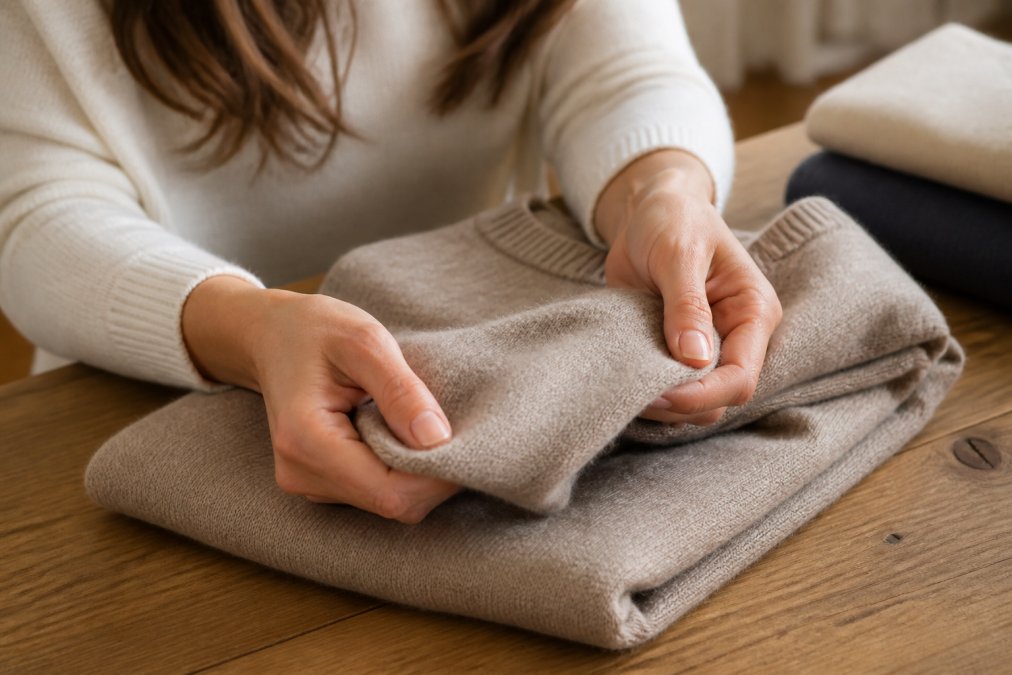
At ISLEFIELD, we source from natural fibers specifically because the hand-feel of genuine cashmere is one of the few qualities that cannot be faked over time. The softness either holds or it doesn't.
Hand-Feel vs. Synthetic Blends
Synthetic blends are the biggest source of confusion for shoppers. Acrylic and polyester fibers can mimic cashmere's initial softness, but they lack two things: breathability and thermal regulation. Cashmere is a natural insulator that adjusts to body temperature. Synthetic blends trap heat or let it escape without modulation. Hold the fabric to a light source. Genuine cashmere has a natural luster and slight translucency. Synthetics look flat and uniform.
Another quick test: rub the fabric gently against your inner wrist for about 30 seconds. Synthetic blends often create a mild static sensation. Pure cashmere does not.
Micron Count: The Number Behind the Softness
Micron count is the measurement of individual fiber diameter in millionths of a meter. It is the single most objective indicator of cashmere softness. Grade A cashmere typically measures between 14 and 16 microns in fiber diameter. Anything above 19 microns will likely feel noticeably coarser against skin.
Most garment labels do not state the micron count. When a brand does publish this figure, it signals transparency about raw material quality. According to The Woolmark Company's fiber quality standards, cashmere fiber must not exceed 19 microns to be certified as genuine cashmere. Fiber below 16 microns is considered exceptional and commands a significant premium in the luxury textile market.
Cashmere Grades Explained: Grade A, B, and C
Cashmere grades are a classification system based on fiber length and diameter, which together determine the softness, durability, and pilling resistance of the finished garment. Grade A is the longest and finest fiber. Grade B is shorter and slightly coarser. Grade C is the lowest commercial grade, with the shortest fiber length and the highest likelihood of pilling.
The grading happens at the raw material stage, before spinning and knitting. This means the grade of your garment is determined long before a brand adds its label.
Grade |
Fiber Length |
Fiber Diameter |
Pilling Risk |
Typical Use |
|---|---|---|---|---|
Grade A |
Long (36mm+) |
14-16 microns |
Low |
|
Grade B |
Medium (26-35mm) |
17-19 microns |
Moderate |
Mid-range garments |
Grade C |
Short (<26mm) |
19+ microns |
High |
Budget blends |
How De-Hairing and Fiber Length Affect Grade
De-hairing is the process of separating the fine undercoat of the cashmere goat from the coarser guard hairs. This step is critical. Inadequately de-haired cashmere will feel scratchy because the guard hairs are significantly thicker than the soft undercoat. Brands that invest in thorough de-hairing produce garments that are genuinely soft from the first wear.
Fiber length matters for a different reason: longer fibers twist together more securely during spinning, creating a yarn with greater structural integrity. Short fibers shed more easily, which is the primary cause of pilling. A garment made from long, well-de-haired Grade A fiber will resist pilling far longer than one made from shorter Grade C material, regardless of how the finished garment looks in a shop.
2 Ply vs 4 Ply Cashmere: Which Should You Choose?
The ply of a cashmere garment refers to how many individual yarn strands are twisted together to form the final knitting yarn. Two-ply cashmere uses two strands twisted together. Four-ply uses four.
This is not a case of more being better. The right ply depends entirely on what you need the garment to do.
Two-ply cashmere is lighter, has better drape, and is ideal for layering or wearing in transitional seasons. It offers excellent breathability and a refined, close-to-body silhouette. Four-ply cashmere is heavier, warmer, and more structured. It holds its shape more assertively and works well for outerwear-weight knitwear or colder climates.
The common mistake is assuming that four-ply signals higher quality. It does not. A four-ply garment made from Grade C fiber is still a Grade C garment. Ply affects warmth and weight. Grade and micron count determine quality.
How to Identify High Quality Cashmere by Reading the Label
The label is where brands either earn trust or lose it. High quality cashmere garments should state "100% cashmere" without qualification. Any label that reads "cashmere blend," "cashmere-like," or "cashmere touch" is not cashmere in any meaningful sense. These terms indicate synthetic or wool blends designed to trade on the cashmere name.
The Federal Trade Commission's textile labeling requirements in the United States require that fiber content be listed accurately by percentage. A garment labeled "cashmere blend" must specify the percentage of cashmere it actually contains. Many blends contain as little as 10-20% cashmere fiber.
Look for the country of origin alongside fiber content. Mongolia, Inner Mongolia, and the Himalayan plateau produce cashmere from goats that grow the finest undercoat due to the extreme cold they endure. Cashmere from these regions tends to have finer fiber diameter and greater natural luster than cashmere from warmer climates.
Spotting Fake Cashmere and Misleading Blends
Fake cashmere falls into two categories: outright synthetic substitutes and diluted blends with misleading labeling. The burn test is a reliable field method for distinguishing natural fibers from synthetics. Pull a small thread from an inconspicuous seam and hold it to a flame. Genuine cashmere burns slowly, smells like burning hair, and leaves a fine ash that crumbles. Synthetic fibers melt, smell chemical, and leave a hard bead of residue.
A common mistake is trusting softness alone as proof of authenticity. Fabric softeners and chemical treatments can make synthetic blends feel convincingly soft in a store. The burn test bypasses all surface treatments and reveals the underlying fiber.
The Elasticity and Post-Wash Tests: Identifying High Quality Cashmere That Lasts
Garment recovery is one of the most telling indicators of cashmere quality, and it is a test you can perform in any shop before you buy. Stretch a section of the fabric gently between both hands, about two inches of lateral stretch, and release it. High-quality cashmere made from long, well-twisted Grade A fiber springs back to its original dimensions almost immediately, within one or two seconds. Low-grade cashmere, or blends with insufficient yarn twist, will stay stretched or recover slowly and unevenly. That slow recovery is a preview of how the garment will behave at the elbows, cuffs, and collar after a month of regular wear.
The elasticity test works because fiber length and yarn twist are mechanically linked to recovery. Longer fibers, Grade A runs to 36mm or more, interlock more securely during spinning. The resulting yarn has a coiled, spring-like structure that reasserts itself after deformation. Shorter Grade C fibers, by contrast, slide past one another under tension rather than springing back, which is why low-grade garments bag out at stress points so quickly.
Post-Wash Performance: The Test No Competitor Discusses
The elasticity test tells you about a garment's structure before it has been stressed by water and agitation. Post-wash performance tells you whether that structure survives real use. This is the ultimate quality test, and it is almost entirely absent from standard buying guides, which is precisely why it matters.
Here is what high-quality cashmere does across repeated washes, and what lower-grade material does instead:
After the first wash: Grade A cashmere washed correctly, cool water, gentle detergent, laid flat to dry, will emerge with its dimensions essentially unchanged, within a few millimetres of its pre-wash measurements. The fiber will feel slightly softer than before washing because the natural lanolin in the fiber redistributes during gentle agitation. Low-grade cashmere or blends often show visible shrinkage or, conversely, stretching, after the first wash. The yarn twist loosens, the knit structure opens up, and the garment loses the clean definition of its original silhouette.
After five washes: This is where fiber length becomes decisive. Long-fiber Grade A yarns maintain their twist integrity through repeated wet-dry cycles. The garment should still hold its shape, and pilling, if it has appeared, should be manageable and confined to high-friction zones like the underarms and cuffs. A short-fiber garment at this stage will typically show significant pilling across broader surface areas, visible thinning at stress points, and a general loss of loft and body.
After ten or more washes: A genuinely high-quality cashmere garment, properly cared for, actually improves in hand-feel over ten or more wash cycles. The fibers settle and align, the surface becomes more even, and the softness deepens rather than diminishing. This is a characteristic of long, fine fiber with sufficient natural crimp. Low-grade cashmere at this stage is typically pilling heavily, has lost significant weight and warmth, and may show areas of thinning where the yarn structure has broken down entirely.
Pilling Resistance and Knit Density
Pilling is the formation of small fiber balls on the surface of a garment, caused by loose fibers tangling together through friction. All cashmere pills to some degree, this is a property of natural protein fibers, not a defect, but the rate, severity, and location of pilling vary enormously by quality tier.
Grade A cashmere with long fibers and tight yarn twist pills slowly and in predictable, manageable locations. Grade C cashmere with short fibers and loose twist pills quickly and across broad surface areas, because there are more free fiber ends exposed at the yarn surface to catch and tangle.
Knit density compounds this effect. Hold the garment up to a light source. A tightly knit structure will be relatively opaque and even. A loosely knit structure will show visible gaps between the yarn loops and will be noticeably more transparent. Loose knit density increases pilling because more fiber surface is exposed to friction with every movement. It also reduces the garment's thermal efficiency, since the insulating air pockets between fibers escape more easily through a loose structure.
If a garment is already showing pills at points of friction, underarms, cuffs, the area where a bag strap crosses the shoulder, before you have worn it, the fiber quality is almost certainly low. New garments should not pill in a shop.
Visual Inspection: Fluffiness, Luster, and Pilling
High-quality cashmere has a natural, soft luster. It reflects light evenly and gently rather than appearing dull, flat, or overly shiny. Run your palm slowly across the surface of the garment. A slight, even fluffiness is normal and desirable in a new piece, this is the natural crimp of the fiber expressing itself at the surface. What you are looking for is evenness. The fluffiness should be consistent across the whole garment.
Excessive or uneven fluffiness, particularly a heavily napped or almost furry surface, is a sign that the garment has been brushed aggressively during finishing to disguise short, low-grade fiber. Brushing raises the fiber ends to create the appearance of softness and loft, but it also weakens the yarn structure and dramatically accelerates pilling. The garment will feel deceptively soft in the shop and deteriorate quickly in use.
Ethical and Sustainable Sourcing: Why the Origin of Raw Material Matters
The origin of cashmere is not just an ethical consideration. It is a direct determinant of fiber quality, and understanding why requires a brief look at the biology of the cashmere goat itself.
Cashmere comes from the soft undercoat, called the duvet, that cashmere goats grow as insulation against extreme cold. The colder and more variable the climate, the denser and finer the undercoat the goat produces. Goats on the high Mongolian steppe and the Himalayan plateau, where winter temperatures regularly fall below minus 30 degrees Celsius, grow an undercoat with a finer fiber diameter and greater natural crimp than goats raised in milder conditions. That crimp is not cosmetic: it is the structural property that gives cashmere its loft, its thermal efficiency, and its ability to recover its shape after stretching. Climate is not a marketing claim. It is a quality variable built into the fiber at the biological level.
How Herd Management Directly Affects Fiber Fineness
The connection between sustainable herding and fiber quality runs deeper than climate alone. Herd density, the number of goats grazing a given area of land, affects fiber quality through two mechanisms that are rarely discussed in standard buying guides.
First, overcrowded herds compete for grazing. Nutritional stress in cashmere goats produces coarser, shorter fiber. A goat that is well-fed on diverse, natural pasture grows a finer, longer undercoat than one subsisting on degraded land. Responsible herders who practice rotational grazing, moving herds between pastures to allow land recovery, are managing for the long-term productivity of their animals, which means they are also managing for fiber quality.
Second, the combing process matters as much as the growing. Traditional hand-combing, practiced by experienced herders during the spring molting season, separates the fine undercoat from the coarser guard hairs with minimal damage to fiber length. Industrial shearing, used in higher-volume operations, cuts both undercoat and guard hair together, producing a raw material that requires more aggressive de-hairing processing and results in shorter average fiber length. Shorter fiber, as discussed in the grading section, means higher pilling risk and lower structural integrity in the finished garment.
The Overgrazing Problem and What It Means for Quality
Demand for cheap cashmere over the past two decades has driven a significant increase in goat populations across Mongolia and Inner Mongolia. As noted by the World Wildlife Fund's sustainable cashmere program, this expansion has contributed to serious land degradation across parts of the Mongolian steppe, with pastureland converting to desert at a measurable rate.
The quality implication is direct: as pastureland degrades, the nutritional quality available to grazing goats declines, and fiber quality follows. The cheapest cashmere on the market is often produced by the largest, most densely stocked herds on the most degraded land. The economics of cheap cashmere and the ecology of degraded pasture are the same problem, viewed from different angles.
Brands that source responsibly, working with smaller, traceable herds and producers who practice rotational grazing, are not simply making an ethical choice. They are accessing a supply chain where the conditions for fine fiber production are actively maintained rather than depleted.
How to Evaluate a Brand's Sourcing Claims
Vague language is the most reliable sign of a weak supply chain. Phrases like "the finest Mongolian cashmere" or "ethically sourced fibers" without supporting specifics should prompt direct questions. Brands with genuine supply chain transparency can typically answer the following:
- Which region of Mongolia, Inner Mongolia, or the Himalayan plateau does the raw fiber come from?
- Do they work with named cooperatives, herder groups, or certified suppliers?
- Can they describe the combing or shearing method used?
- Do they have any third-party certification, such as the Sustainable Fibre Alliance's Responsible Cashmere Standard, or are they working toward one?
Brands that deflect these questions, or respond only with marketing language, are almost certainly purchasing fiber through multi-tier commodity markets where traceability ends at the first processor. That is not inherently dishonest, but it does mean the brand cannot verify the conditions under which its fiber was produced, which means neither can you.
The Practical Implication for Shoppers
Sustainable sourcing and fiber quality are correlated, not identical. A brand can source responsibly and still produce a mid-grade garment. But the inverse, a brand producing consistently fine, long-fiber Grade A cashmere from an opaque, high-volume commodity supply chain, is far less common. The investment required to maintain fiber quality at the raw material stage tends to coexist with the investment required to maintain responsible herding practices. Both require closer relationships with producers, smaller batch sizes, and a willingness to pay more for raw material than the commodity market demands.
At ISLEFIELD, small-batch production allows for the kind of supply chain oversight that makes these distinctions meaningful in practice. Ask the brands you buy from where their cashmere comes from. The specificity of the answer will tell you a great deal about the quality of the fiber inside the garment.
How to Care for Cashmere Sweaters to Protect Your Investment
Proper care is what separates a cashmere garment that lasts a decade from one that deteriorates after a season. The single most damaging thing you can do to cashmere is machine wash it on a regular cycle. Agitation causes the fibers to felt, which is an irreversible matting process that shrinks and stiffens the fabric permanently.
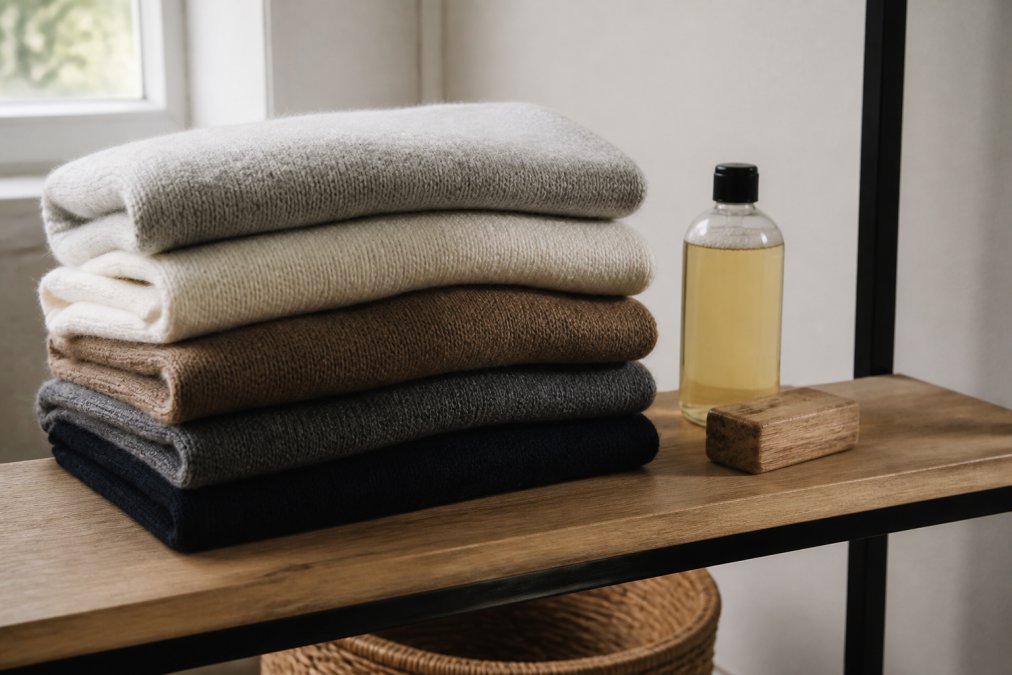
Hand washing in cool water with a gentle wool wash is the standard approach. Lay the garment flat to dry on a clean towel, reshaping it to its original dimensions while damp. Never hang a wet cashmere garment; the weight of the water will stretch it out of shape.
The care routine that preserves high quality cashmere over years:
- Hand wash in cool water with a small amount of wool-specific detergent
- Gently press water out without wringing or twisting the fabric
- Lay flat on a dry towel and roll the towel to absorb excess moisture
- Reshape the garment to its original dimensions and dry flat away from direct heat or sunlight
- Store folded, not hung, in a breathable cotton bag during off-season
- Use cedar blocks or lavender sachets rather than chemical moth repellents
Pilling that develops through regular wear can be managed with a cashmere comb or fabric shaver. Use light, even strokes. This is maintenance, not a sign of poor quality. Even Grade A cashmere will develop surface pills over time in high-friction areas.
According to the Textile Care Alliance's fiber care guidelines, cashmere should be washed no more than once every three to five wears to preserve the natural oils in the fiber that maintain its softness. Over-washing strips these oils and leads to premature dryness and brittleness.
Care Step |
Method |
Frequency |
|---|---|---|
Washing |
Hand wash, cool water |
Every 3-5 wears |
Drying |
Flat dry, reshape damp |
After every wash |
De-pilling |
Cashmere comb or shaver |
As needed |
Storage |
Folded, breathable bag |
Off-season |
Moth protection |
Cedar or lavender |
Year-round |
Identifying high quality cashmere requires looking past the label and the price tag to the underlying fiber. The micron count, grade, ply, and sourcing practices all determine whether a garment will hold up over years of daily wear or disappoint within a season. ISLEFIELD's small-batch knitwear is crafted from premium natural fibers with the kind of quality controls that make these distinctions matter in practice. Every piece is designed to be lived in, not just admired. Shop the ISLEFIELD collection and invest in cashmere that earns its place in your wardrobe.
Frequently Asked Questions
Q: What is the highest grade of cashmere?
A: Grade A is the highest grade of cashmere, made from the finest, longest fibers with a diameter of around 14-15.5 microns. These fibers come from the underbelly of the cashmere goat and go through rigorous de-hairing to remove coarser guard hairs. Grade A cashmere produces the softest, most durable garments with excellent pilling resistance and shape retention after washing. It costs more, but the thermal properties, longevity, and hand-feel justify the difference for anyone buying to wear regularly.
Q: Does high quality cashmere pill?
A: All cashmere pills to some degree during early wear as loose surface fibers work their way out. High quality cashmere made from long, tightly twisted Grade A fibers pills far less than lower-grade or blended alternatives. A well-knitted two-ply or four-ply garment with high knit density will stabilize quickly and stop pilling after a few wears. If a sweater continues to pill heavily after several washes, that usually signals short fibers, a loose knit gauge, or a synthetic blend rather than pure cashmere.
Q: How do you identify authentic cashmere?
A: Start with the label: it must state 100% cashmere with no added fibers. Then run the touch test: authentic cashmere feels immediately soft without scratchiness, and it warms to your skin quickly due to its natural thermal properties. Stretch a section gently and release it; high quality cashmere recovers its shape. Hold the fabric up to light and look for an even, dense knit with a natural luster rather than a synthetic sheen. Price is also a reliable signal: genuine cashmere from Grade A fibers cannot be produced cheaply.
Q: Is 2 ply or 4 ply cashmere better?
A: Neither is universally better; they serve different purposes. Two-ply cashmere is lighter and ideal for layering or transitional seasons, while four-ply is heavier, warmer, and more structured for cold weather or standalone outerwear. Both can be high quality cashmere if made from Grade A fibers with a tight yarn twist and appropriate knitting gauge. The ply count affects garment weight and insulation, not the inherent quality of the raw fiber. Choose based on how and when you plan to wear the piece.
Q: What should I expect to pay for genuinely high quality cashmere?
A: Pricing for high quality cashmere varies based on fiber grade, ply count, production scale, and brand sourcing practices. What is consistent is that Grade A, 100% cashmere garments from ethical, small-batch producers cannot be made at fast-fashion price points. If a price seems too low for a claimed premium product, the fiber grade, yarn twist, or blend composition is likely the compromise. Check the brand's website directly for current pricing and look for transparency around sourcing and production methods as a quality indicator.
Q: How does sustainable sourcing affect cashmere quality?
A: Ethical and sustainable sourcing directly influences fiber quality. Cashmere goats raised in low-stress, well-managed environments produce finer, longer fibers with better natural luster and moisture-wicking properties. Overcrowded herds and overgrazing lead to stressed animals whose fibers become coarser over time. Brands that can trace their raw material back to responsible herding practices and certified de-hairing facilities are more likely to deliver consistent Grade A fiber. Sustainable sourcing is both an ethical position and a quality signal worth asking about before purchasing.
This article was written using GrandRanker